Food Systems and Agricultural Resilience under Climate Stress
Leila Haddad, Ingrid Solberg Halvorsen · 18 November 2025
By Leila HaddadIngrid Solberg Halvorsen
An evidence-led assessment of how climate stress is reshaping the economics and stability of global food systems, with transparent scenario ranges to 2030 for policymakers, investors and international organisations.
Executive summary
The global food system is at once a major source of climate stress and one of its most exposed victims. Producing, moving, processing and disposing of food accounts for roughly a quarter to a third of anthropogenic greenhouse-gas emissions, depending on system boundaries; the same system depends on stable temperature, rainfall and growing-season patterns that warming is progressively unsettling. This two-way dependency is the central fact of the sector's medium-term outlook. It means that food security, agricultural investment returns and rural livelihoods are all being repriced against a climate baseline that no longer holds steady, and that mitigation and adaptation are not separable agendas but a single problem viewed from two angles.
The economics have tightened. Global agricultural total factor productivity — the efficiency with which land, labour, capital and inputs are converted into output — has been growing more slowly than in the 1990s and 2000s, at a pace near 1% per year in recent estimates. That deceleration matters because the twentieth-century model of feeding a growing population relied on productivity gains outrunning demand, allowing output to rise without proportional expansion of cropland. If productivity growth stays soft while climate variability raises the frequency of poor harvests, the system loses the buffer that historically absorbed shocks. The result is not a single dramatic failure but a higher baseline of volatility: more frequent price spikes, thinner stocks and sharper regional divergence between surplus and deficit.
Concentration compounds the exposure. A small number of breadbasket regions, a handful of globally traded staples, and a short list of fertiliser and grain-trading firms sit at the centre of the network — a structure that delivers efficiency in normal years and contagion in bad ones. The 2021–2023 period showed how a regional disturbance propagates into synchronised global price movements and acute distress in import-dependent low-income countries. The physical climate now adds a correlated risk that classical diversification handles poorly: simultaneous heat and drought across multiple breadbaskets in the same year.
This report frames the sector for decision-makers acting under genuine uncertainty. We size the principal market segments as transparent estimates, map the structural dynamics, and offer three named scenarios to 2030. Our central judgement is that resilience is now the binding constraint on value in food and agriculture: the returns to productivity, the stability of public finances in food-importing states, and the durability of private supply chains increasingly depend on how well the system absorbs shocks rather than how much it produces in an average year.
Key conclusions
- Food systems are both a climate driver and a climate casualty. Emissions from agriculture, land-use change and the wider food chain are large enough that the sector cannot be excluded from any credible mitigation path, yet the same system faces rising physical losses from heat, drought, flooding and shifting pest ranges. Policy that treats the two sides in isolation will under-deliver on both.
- Productivity growth has decelerated at the wrong moment. With global agricultural total factor productivity growth near 1% per year, the historical margin that let output rise faster than cultivated area has narrowed. Closing the gap through land expansion would raise emissions and biodiversity loss, tightening the mitigation constraint.
- The heat sensitivity of staples is well documented. Peer-reviewed synthesis finds mid-single-digit percentage yield declines per additional degree of warming for wheat, rice, maize and soybean absent adaptation and carbon-fertilisation offsets. These four crops supply roughly two-thirds of human calories, so their aggregate response dominates the food-security outlook.
- Structural concentration turns local shocks into global events. Reliance on a few export regions, a short list of traded staples and concentrated input and trading firms means disturbances synchronise rather than diversify. Correlated multi-breadbasket weather failure is the tail risk most likely to produce a severe global price event this decade.
- Smallholders carry disproportionate exposure. Farms under two hectares represent most of the world's holdings and produce roughly a third of food, yet operate with minimal financial buffers, limited insurance and high sensitivity to input-price and weather swings.
- Resilience, not maximal yield, is becoming the value axis. The decision-relevant question is shifting from average productivity to the distribution of outcomes — how deep the bad years are and how quickly systems recover — repricing assets, insurance and sovereign food-import risk alike. Adaptation finance, meanwhile, remains a modest share of total agricultural capital flows.
1. Context and why it matters
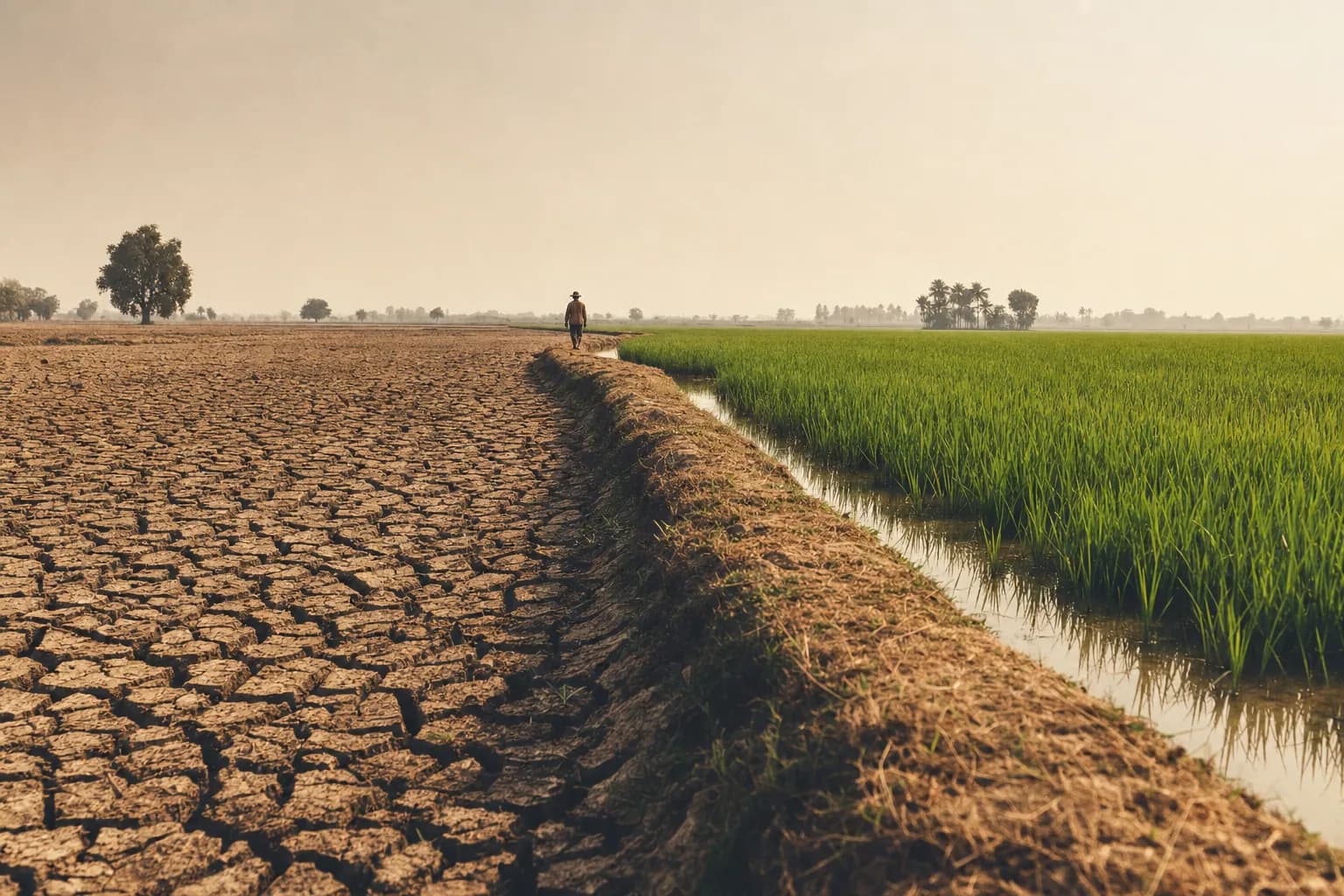
Roughly 8 billion people depend on a food system built during a period of unusually stable climate. The post-war expansion of agricultural output — driven by improved genetics, synthetic nitrogen, mechanisation, irrigation and expanded trade — roughly kept pace with a population that has more than tripled since 1950. That achievement rested on an implicit assumption: that the physical envelope of temperature, precipitation and season length within which crops and livestock evolved would remain broadly constant. That assumption is weakening.
The stakes are simultaneously humanitarian, economic and geopolitical. Hundreds of millions of people remain undernourished, and a much larger number — on the order of two billion — experience moderate or severe food insecurity at some point in a given year; these figures had been falling for decades before stalling and partially reversing in the early 2020s under conflict, economic shocks and weather extremes. Agriculture directly generates several trillion dollars of value added and underpins a food-and-beverage consumer market several times larger, while employing a substantial, lower-income-concentrated share of the global workforce. And food is a strategic commodity: export restrictions, stockpiling and the weaponisation of grain corridors have repeatedly shown that food security and national security are entangled.
Why does climate stress deserve a dedicated flagship treatment now? Three reasons. First, the signal has become detectable in the data: attribution studies increasingly tie specific harvest failures and price events to warming and altered variability, moving the discussion from projection to observation. Second, the correlation structure of risk is changing in a way markets and insurers are not fully priced for — the possibility of simultaneous rather than sequential breadbasket shocks. Third, the policy window is narrowing: infrastructure, genetics and land-use decisions taken this decade lock in resilience or fragility for the 2040s, because irrigation, tree crops, breeding pipelines and settlement patterns all have long lead times. Decisions deferred are not neutral; they compound.
The system's recent record — and the long lead times of the decisions taken now — can be read as a single trajectory from a stable baseline toward a narrowing policy window.
- Since 1950Population more than tripled
Post-war output roughly kept pace via improved genetics, synthetic nitrogen, mechanisation, irrigation and expanded trade — on the assumption of a broadly constant climate envelope.
- 2021–2023Synchronised global price event
A regional disturbance propagated into synchronised global price movements and acute distress in import-dependent low-income countries.
- 2022Fertiliser price spike
Because synthetic nitrogen ties food costs to natural-gas prices, an energy and geopolitical shock raised production costs sharply even in a good growing year.
- This decadeDecisions lock in the 2040s
Irrigation, tree crops, breeding pipelines and settlement patterns all have long lead times, so choices taken now set resilience or fragility for the 2040s.
- By mid-centuryFood demand could rise ~50% or more
Relative to the early 2010s, per widely cited institutional analyses; sensitive to assumptions about diet, waste and population.
2. Market structure and scale
The food and agriculture complex resists a single headline number because its boundaries are contested. The narrowest measure — agricultural value added in national accounts — captures only the margin created at the farm level; the broadest — total consumer spending on food and beverages — captures processing, logistics, retail and food service, most of whose value is created downstream. We present segment estimates rather than one aggregate, and state the basis for each.
The estimates below are indicative orders of magnitude drawn from public national-accounts data, industry trade statistics and institutional reporting. Several segments — fertilisers and crop insurance in particular — are highly volatile, so we give ranges and treat any single figure as a midpoint, not a measurement.
| Segment | Indicative scale (annual) | Confidence | Basis / notes |
|---|---|---|---|
| Agricultural value added (farm-level, national accounts) | ~US$3.5–4.0 trillion | Medium-high | World Bank / national-accounts style aggregates; established concept, boundary-sensitive |
| Gross value of primary crop & livestock production (farm gate) | ~US$4–5 trillion | Medium | FAO gross-production-value style measure; overlaps partly with value added |
| Consumer food & beverage market (retail + food service) | ~US$8–10 trillion | Medium | Downstream consumer spend; most value added off-farm |
| Fertilisers | ~US$190–240 billion | Low-medium | Highly price-volatile; spiked materially higher in 2022 before easing |
| Agricultural machinery | ~US$150–175 billion | Medium | Tractors, harvesters, implements; capital-cycle sensitive |
| Crop protection (agrochemicals) | ~US$70–85 billion | Medium | Herbicides, fungicides, insecticides |
| Seeds (commercial) | ~US$60–75 billion | Medium | Excludes farm-saved seed, which remains large in smallholder systems |
| Agricultural / crop insurance (premiums) | ~US$45–55 billion | Low-medium | Heavily concentrated in a few subsidised markets; thin in most low-income countries |
| Precision agriculture / agtech | ~US$18–28 billion | Low | Definition-dependent; spans hardware, software, data services |
| Irrigation equipment | ~US$10–14 billion | Low-medium | Drip, sprinkler, pivot systems; adaptation-relevant |
Setting aside the trillion-scale output measures, the input, technology and risk-transfer segments that resilience investment actually flows through fall in a comparable band. Taking the midpoint of each range above shows where that spend concentrates today.
- Fertilisers35%
- Agricultural machinery27%
- Crop protection13%
- Seeds (commercial)11%
- Crop insurance (premiums)8%
- Precision agriculture / agtech4%
- Irrigation equipment2%
Two structural features matter more than the totals. First, value concentrates downstream while risk concentrates upstream. The thin farm-level margin bears the brunt of weather and input-price volatility, while the larger downstream value pool is comparatively insulated and can pass costs to consumers. This asymmetry helps explain chronic under-investment in on-farm resilience: the actors most exposed to physical risk capture the least of the system's value.
Second, input and trading markets are concentrated. A small number of firms dominate globally traded grains and oilseeds, and fertiliser production is concentrated around a handful of exporting countries with the requisite gas, phosphate or potash endowments. Concentration lowers cost in stable conditions but creates single points of failure: when one node — a major exporter, a shipping corridor, a gas price — is disturbed, the effect propagates system-wide rather than being absorbed locally.
The demand side adds pressure. Population growth, though decelerating, continues; more consequential is the shift in diet composition as incomes rise in emerging economies, raising demand for animal protein and thus for feed grains and grazing land. Widely cited institutional analyses suggest food demand could rise on the order of 50% or more by mid-century relative to the early 2010s, though the figure is sensitive to assumptions about diet, waste and population. Meeting it without proportional land expansion requires sustained productivity growth — precisely the variable that has been softening.
3. Drivers and physical dynamics
The physical mechanism linking climate to food output is direct for crops and indirect but material for livestock and fisheries. For staple crops, heat during critical growth stages — flowering, grain-filling — reduces yield, and the relationship is non-linear: damage accelerates once temperatures cross crop-specific thresholds. Peer-reviewed synthesis of field trials, statistical models and process-based crop models converges on a broadly consistent picture for the four dominant staples.
| Staple crop | Approx. global yield change per +1°C | Share of the calorie picture |
|---|---|---|
| Maize | ~ −7% | Among the largest single crops by tonnage; key feed grain |
| Wheat | ~ −6% | Dominant staple across temperate and subtropical zones |
| Rice | ~ −3% | Primary calorie source for much of Asia |
| Soybean | ~ −3% | Central to feed and edible-oil supply chains |
Estimated yield loss per +1°C of warming
| Staple crop | Yield loss per +1°C |
|---|---|
| Maize | 7% |
| Wheat | 6% |
| Rice | 3% |
| Soybean | 3% |
These figures are global means without adaptation and without the offsetting effect of carbon-dioxide fertilisation, which can partially compensate for some crops under some conditions. The point estimates carry uncertainty and vary sharply by region: high-latitude zones may see growing-season gains, while already-hot low-latitude zones — where many food-insecure populations live — face the steepest losses. The four crops matter disproportionately because together they supply roughly two-thirds of human calories directly or through feed, so their aggregate heat response, weighted by production geography, largely determines the global outlook.
Beyond mean temperature, three forms of variability drive the resilience problem. Precipitation extremes — both drought and intense rainfall — damage output at either tail, and warming intensifies both. Compound and correlated events — heat coinciding with drought, or shocks striking several breadbaskets in one season — are the tail conventional planning underweights, because diversification across regions fails when the regions fail together. Shifting biological ranges — pests, pathogens and weeds moving into newly hospitable zones — erode yields in ways that lag temperature and resist modelling.
Water is the connective constraint. Agriculture accounts for the large majority of global freshwater withdrawals, and irrigation underpins a disproportionate share of output relative to its land footprint. Warming raises crop water demand even where rainfall is unchanged, and many systems already draw on aquifers faster than they recharge — translating climate stress into a hard limit on the irrigated intensification that has historically buffered rain-fed variability.
Two mediating factors can blunt or sharpen these dynamics. The first is input dependence. Modern high-yield agriculture is energy- and fertiliser-intensive; synthetic nitrogen ties food costs to natural-gas prices and concentrates emissions as nitrous oxide, linking food-price stability to energy-market volatility, as the 2022 fertiliser spike illustrated. The second is loss and waste. A large share of food — on the order of a third across the chain when post-harvest loss and consumer waste are combined — never reaches a stomach. Reducing it eases the demand-growth constraint without new land or water, and is among the more cost-effective resilience levers available.
4. Regional and comparative lens
Climate stress does not distribute its costs evenly, and the geography of exposure diverges sharply from the geography of contribution and adaptive capacity.
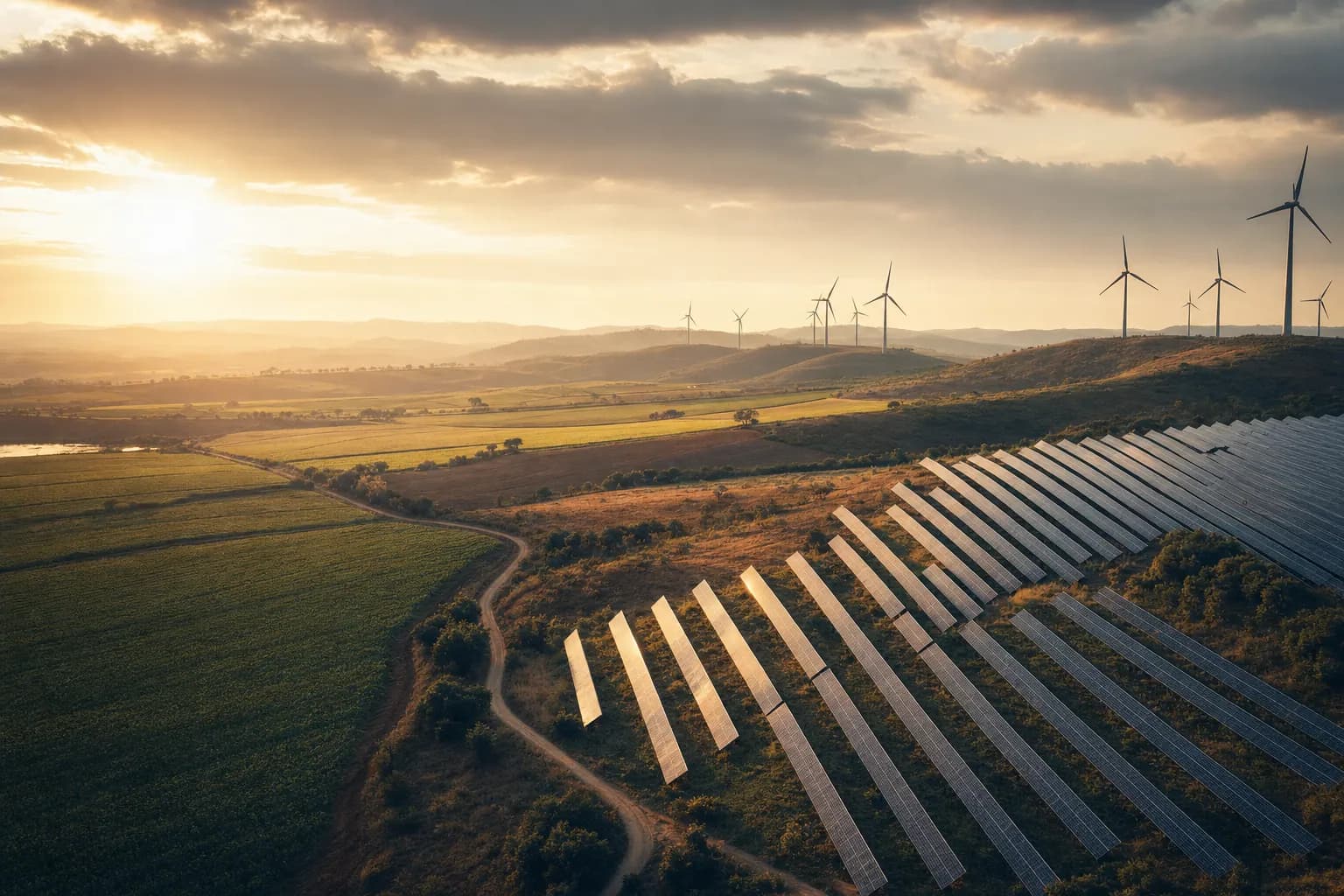
Sub-Saharan Africa combines high physical exposure, low irrigation penetration, rapid population growth and thin fiscal buffers. Agriculture employs a large share of the workforce, much of it in rain-fed smallholder systems with limited access to improved genetics, credit or insurance. The region is at once where productivity gains would deliver the greatest food-security dividend and where the enabling conditions — research funding, extension, functioning markets, storage — are least developed. It is the clearest case for adaptation investment with an outsized humanitarian return.
South and South-East Asia host dense populations dependent on rice and wheat systems sensitive to heat extremes and monsoon variability and reliant on groundwater already under stress. The region has stronger irrigation and research capacity than Sub-Saharan Africa, but the scale of population exposed means even moderate yield shocks carry large absolute consequences, and aquifer depletion sets a hard medium-term ceiling.
The major exporting breadbaskets — North and South America, the Black Sea region, Australia and parts of Europe — are the system's shock absorbers and its single points of failure. Their surpluses feed the import-dependent world, so weather in these zones is transmitted globally through price. The strategic concern is not the average performance of any one but the rising probability that several underperform simultaneously, which would exhaust the buffer of stocks and spare export capacity that normally cushions a single regional failure.
High-income food importers in the Gulf and parts of East Asia face limited physical exposure at home but concentrated import dependence, and have responded with strategic reserves, overseas land acquisition and supply-chain diversification. Low-income food-deficit countries face the harshest combination: import dependence, weak purchasing power, and currency and debt vulnerability that turn a global price spike into a fiscal and balance-of-payments crisis. For this group, food-price volatility is not only a market phenomenon but a driver of macroeconomic and political instability.
The comparative lesson is that resilience is as much about institutions as about weather. Two regions facing similar physical shocks can experience very different outcomes depending on the depth of their markets, the reach of their safety nets, the diversity of their import sources and the strength of their early-warning and reserve systems. Adaptation cannot be reduced to agronomy; it is equally a question of finance, trade policy and public administration.
5. Competitive landscape and the resilience opportunity
The commercial response to climate stress is reshaping several adjacent markets, and the competitive terrain is worth mapping because it determines where private capital can complement public action.
Genetics and crop science sit at the centre. Breeding for heat, drought and salinity tolerance, shorter maturation and pest resistance is the most direct lever on the yield-response curves above. The segment is concentrated among a few large firms with the research budgets and regulatory reach to commercialise stress-tolerant traits, alongside a public and philanthropic breeding system that serves crops and geographies the commercial sector underserves. The competitive question is whether trait development can keep pace with a moving climate baseline — an adaptation treadmill in which the target shifts as the pipeline matures.
Risk transfer and finance is an underdeveloped frontier. Crop insurance is concentrated in a few heavily subsidised high-income markets and remains thin across the low-income world where exposure is highest. Index-based and parametric products — which pay out on a measured weather trigger rather than an assessed loss — cut administrative cost and moral hazard and suit smallholder contexts, but face basis risk and need reliable weather data. Scaling affordable risk transfer is among the highest-leverage interventions available: it converts catastrophic, uninsurable volatility into a manageable annual cost and thereby makes on-farm investment bankable.
Precision agriculture and data services promise input efficiency — applying water, nitrogen and crop protection where and when needed — with cost and emissions benefits, but the segment's scale is easy to overstate: adoption is constrained by capital cost, connectivity and smallholder fragmentation, so near-term impact concentrates in large commercial operations. Irrigation and water technology, by contrast, addresses the binding water constraint directly and has a clearer adaptation logic, particularly efficient drip and sensor-guided systems in water-scarce zones.
Storage, logistics and post-harvest systems are the least glamorous and among the most cost-effective resilience investments, because cutting post-harvest loss adds effective supply without new land, water or emissions; in many low-income systems, inadequate storage converts a good harvest into a glut-and-spoilage cycle that depresses incomes and wastes calories.
The through-line is that the landscape is reorganising around resilience rather than raw output: capital positioned in stress-tolerant genetics, risk transfer, water efficiency and post-harvest infrastructure is aligned with where the constraint is tightening, though the public-good character and uncertain payback of these assets is why blended public-private structures matter.
6. What could invalidate this view
Any forward view of this sector should foreground what could invalidate it. We flag four sources of material uncertainty.
Correlated breadbasket failure is the dominant tail risk. Most planning assumes regional shocks are independent, so surpluses elsewhere cover a local shortfall. Warming raises the probability that major producing regions suffer heat or drought in the same season, exhausting stocks and spare capacity and producing a price event more severe than anything in the recent record. The probability is genuinely uncertain, but it is not negligible, and it is rising.
Input and energy shocks can strike independently of weather. Because synthetic nitrogen ties food costs to gas prices, an energy or geopolitical disturbance can raise production costs sharply even in a good growing year, as in 2022; fertiliser-market concentration amplifies the channel.
Policy overreaction is a recurring self-inflicted risk. In past price spikes, export bans and panic stockpiling by individual states amplified the initial shock, converting a supply problem into a coordination failure. The instinct to secure domestic supply is politically rational and collectively damaging, with no reliable mechanism preventing its recurrence.
The productivity trajectory is a two-sided uncertainty. If agricultural research delivers a step-change in stress tolerance and efficiency, much of the downside eases; if productivity growth stays soft, the demand-supply gap widens and land-use pressure intensifies. Public agricultural research budgets, which have grown slowly in several high-income economies, are a leading indicator worth watching. Alongside them sit hard data and attribution limits — yield-response estimates carry real uncertainty, carbon-fertilisation effects are debated, and smallholder and informal production is poorly measured — so point projections, including those here, should be read as central tendencies within wide bands.
The outlook to 2030
We offer three scenarios, distinguished by two variables: the frequency and correlation of physical shocks, and the quality of the policy and investment response. They are illustrative, not forecasts, and the ranges are deliberately wide.
A — Coordinated adaptation
Plausible upside
Physical shocks stay roughly in line with recent trend and the policy response improves: adaptation finance scales, stress-tolerant genetics spread, risk transfer broadens, trade stays open and reserves are managed cooperatively.
- Physical shocks
- ~ recent trend
- Policy response
- Improves, coordinated
- Price volatility
- Elevated but manageable
- Productivity growth
- Recovers modestly
B — Volatile muddling-through
Central case
Physical variability rises gradually — more frequent single-region shocks and occasional near-correlated events — while the policy response stays uneven. Bad years become deeper and more frequent, with pain skewed toward the least resilient regions.
- Physical shocks
- Rise gradually
- Policy response
- Uneven
- Price volatility
- Structurally higher
- Productivity growth
- Soft, ~1%/yr
C — Compound shock
Low annual odds, severe
A correlated multi-breadbasket failure coincides with an input or energy disturbance, and policy responds with export restrictions and stockpiling that amplify it. Stocks draw down, prices spike, and import-dependent economies face food, fiscal and currency stress.
- Physical shocks
- Correlated, multi-breadbasket
- Policy response
- Export bans, stockpiling
- Price volatility
- Sharp spike
- Productivity growth
- Overwhelmed
Scenario A — Coordinated adaptation. Physical shocks stay roughly in line with recent trend rather than accelerating, and — critically — the policy response improves: adaptation finance scales, stress-tolerant genetics reach more farmers, risk-transfer instruments broaden, trade stays open through price events, and reserves are managed cooperatively. Food-price volatility is elevated relative to the 2010s but manageable; productivity growth recovers modestly; the humanitarian burden stabilises. This is achievable but requires sustained coordination that recent history shows is difficult — a plausible upside rather than a base case.
Scenario B — Volatile muddling-through (central). Physical variability rises gradually, producing more frequent single-region shocks and occasional near-correlated events, while the policy response remains uneven — strong in some jurisdictions, weak in many. Prices are structurally more volatile, with periodic spikes that stress import-dependent low-income states; productivity growth stays soft near recent rates; and adaptation investment grows but lags need. The system does not break, but its bad years become deeper and more frequent, and the distribution of pain skews toward the least resilient regions. This is our central expectation absent a decisive shift in either shocks or policy.
Scenario C — Compound shock. A correlated multi-breadbasket failure coincides with an input or energy disturbance, and policy responds with export restrictions and stockpiling that amplify the event. Stocks draw down, prices spike sharply, and import-dependent economies face simultaneous food, fiscal and currency stress with attendant political instability. The probability in any single year is low, but it compounds over the decade, and the consequences are severe enough to dominate risk planning even at modest annual odds. Reserves, diversification and safety nets should be stress-tested against it.
Across all three, the direction of travel is the same: resilience — the depth and frequency of bad years and the speed of recovery — matters more to outcomes than average productivity. The scenarios differ mainly in how well institutions convert a more volatile physical baseline into a survivable economic one.
“Resilience is now the binding constraint on value in food and agriculture.”
Implications and recommendations
Governments and policymakers
Treat food-system resilience as national infrastructure, not sectoral subsidy. The highest-return public actions are unglamorous: reliable reserves managed to dampen rather than amplify price signals, credible commitments against export bans during shocks, investment in storage and transport to cut post-harvest loss, and social safety nets that scale quickly when prices spike. Sustaining public agricultural research is a slow-acting but foundational lever, because the breeding pipeline that determines 2035 yields is being funded — or not — now. Import-dependent states should prioritise diversified supply sources and the fiscal space to absorb price shocks without cutting essential spending.
Business and investors
The value axis is shifting from maximal yield toward resilience, and portfolios should reflect it. Segments aligned with the tightening constraints — stress-tolerant genetics, water-efficient irrigation, risk transfer, and post-harvest and storage infrastructure — face structural tailwinds, though many carry public-good characteristics that favour blended over pure private finance. On the risk side, physical and transition exposure should be assessed at the asset level: correlated weather risk is poorly captured by conventional diversification, and supply chains dependent on a single sourcing region or input node warrant explicit contingency. Repricing of agricultural land, insurance and food-import exposure is likely to continue as the volatility regime becomes better understood.
International organisations and donors
The concentration of exposure in low-income, food-deficit and smallholder-dominated economies is precisely where private capital is least willing to go, which defines the role for concessional and catalytic finance. Priorities include scaling affordable index-based insurance, funding public and orphan-crop breeding for underserved geographies, strengthening early-warning and reserve systems, and supporting the market plumbing — extension, credit, storage — that converts agronomic potential into realised resilience. Coordination to prevent beggar-thy-neighbour export restrictions is a public good only multilateral actors can supply.
Methods, sources and limits
This report is a synthesis rather than primary data collection. It draws on three kinds of material: public statistical series on agricultural output, trade, prices and food security from national statistical agencies and international bodies; the peer-reviewed climate-and-yield literature, including field-trial meta-analyses and crop-modelling studies; and institutional projections and market reporting on input, machinery, insurance and technology segments.
We distinguish deliberately between established and estimated figures. Established macro facts — the broad scale of agricultural value added, the dominance of four staples in the calorie supply, the large agricultural share of freshwater withdrawal, the direction and approximate magnitude of crop heat sensitivity — are presented as settled to a reasonable confidence. Market-segment sizes in Section 2 are indicative estimates: they are order-of-magnitude figures compiled from public and industry sources, given as ranges or midpoints, and flagged by confidence level. Several — fertilisers, crop insurance, agtech — are volatile or definition-dependent and should be read as illustrative scale, not measurement.
All forward-looking figures are scenario ranges, not forecasts. The yield-response coefficients are drawn from published synthesis and carry real uncertainty; they exclude, or only partially incorporate, adaptation and carbon-fertilisation effects and vary substantially by region. The scenarios in the outlook section bracket plausible futures under stated assumptions about shock frequency and policy quality; they are analytical tools for stress-testing decisions, and their probabilities are informed judgements rather than modelled estimates. Where we are uncertain, we have said so; where the data are thin — notably smallholder and informal production — we have flagged the limitation rather than papering over it.
This analysis is independent and non-partisan. It was not commissioned by, and does not represent the interests of, any producer, input supplier, trader or government. Errors of synthesis are the authors' own.
References and data sources
The public statistical series and institutional flagships below were read directly; the crop-climate coefficients in Section 3 are synthesised from the peer-reviewed meta-analyses noted at the end.
- FAO, IFAD, UNICEF, WFP and WHO (2024). The State of Food Security and Nutrition in the World 2024. FAO, Rome.
- Food and Agriculture Organization (2023). The State of Food and Agriculture 2023. FAO, Rome.
- Intergovernmental Panel on Climate Change (2022). Sixth Assessment Report, Working Group II: Impacts, Adaptation and Vulnerability. IPCC, Geneva.
- United States Department of Agriculture, Economic Research Service (2024). International Agricultural Productivity (total factor productivity) database. USDA ERS, Washington, DC.
- International Food Policy Research Institute (2024). 2024 Global Food Policy Report. IFPRI, Washington, DC.
- Agricultural Market Information System (2024). AMIS Market Monitor. AMIS Secretariat, FAO, Rome.
- World Bank (2024). Food Security Update. World Bank, Washington, DC.
- CGIAR (2023). Climate adaptation and stress-tolerant crop breeding: research portfolio review. CGIAR System Organization, Montpellier.
- Peer-reviewed crop–climate meta-analyses (2017–2023) on staple-crop yield sensitivity to warming, synthesised for the coefficients in Section 3.
Authors
Fellow, Climate, Environment & Resources
ORCID 0000-0002-1189-6645Director, Economics & Development Programme
ORCID 0000-0003-1926-5589
Suggested citation
Haddad, L. & Halvorsen, I. S. (2025). Food Systems and Agricultural Resilience under Climate Stress. IRI Flagship Series No. 2025-008. International Research Institute. DOI: 10.62371/iri.2025.008